
How Custom Inventory Labels Improve Control



What Can We Help You With?
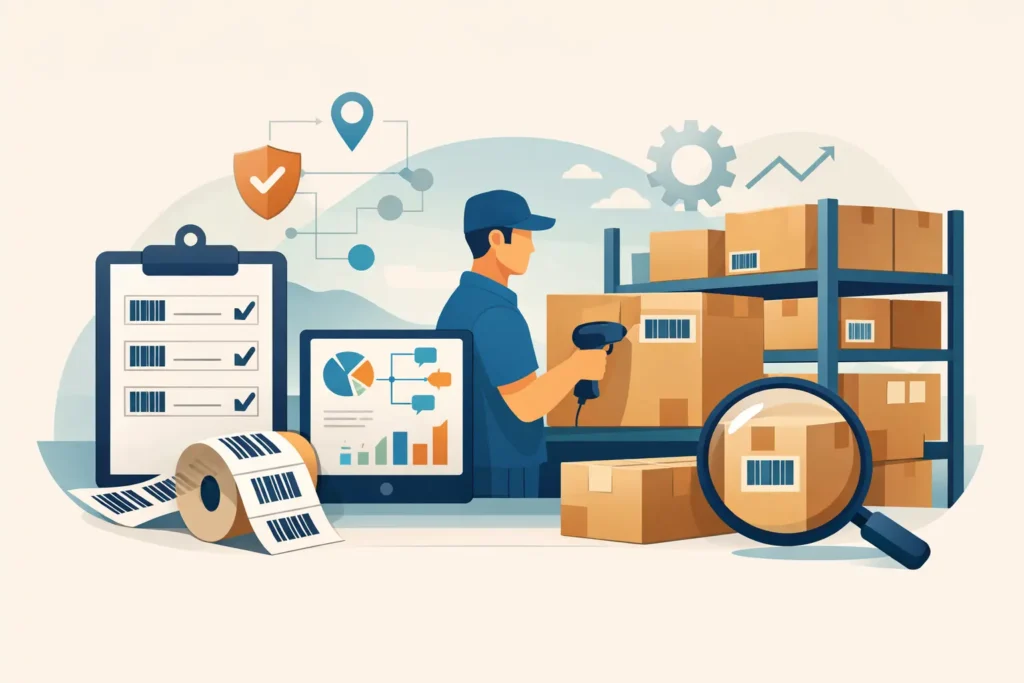
A missing pallet location, a barcode that will not scan, or a handwritten shelf tag that means something different on each shift – those small failures add up fast. Custom inventory labels are often one of the simplest ways to improve inventory accuracy, shorten search time, and create more reliable warehouse and production workflows.
For many operations, the issue is not whether labels are being used. It is whether the labels were designed for the actual environment, equipment, and process. A generic label might work on day one. It may not hold up to abrasion, temperature swings, chemical exposure, outdoor storage, or repeated handling. It may also fail at the systems level if the barcode format, size, adhesive, or print method does not match the application.
Why custom inventory labels matter
Inventory labels do more than mark a box or shelf. They connect physical items to the data used for receiving, put-away, picking, cycle counting, shipping, and traceability. When that connection is weak, operations teams usually feel the effects first. Pick paths get longer, counts become less trustworthy, and exception handling starts consuming time that should be spent on throughput.
Custom inventory labels help close those gaps because they are built around the way your operation actually works. That can mean matching label size to bin locations, choosing materials that stay readable in freezer or outdoor conditions, or creating barcode formats that your scanners and software can process consistently. In regulated or highly controlled environments, customization may also support lot tracking, date coding, serialized inventory, or internal compliance needs.
There is also a practical financial case. Reprinting labels, replacing failed tags, correcting inventory errors, and troubleshooting poor scan performance all create labor costs. Those costs are easy to underestimate because they are spread across departments. A better label specification often reduces those recurring issues more than teams expect.
What makes custom inventory labels different
The word custom can mean a few different things, and that matters during evaluation. Some companies only need a preprinted label with a specific layout, logo, location code, or numbering sequence. Others need a full system built around variable data printing, barcode standards, and hardware compatibility.
In most industrial settings, customization falls into four connected areas: material, adhesive, print technology, and data design. Material affects durability and print quality. Adhesive determines whether the label stays in place on corrugate, plastic, metal, wood, or returnable containers. Print technology shapes speed, clarity, and long-term readability. Data design governs what users see and what systems can scan.
These choices are not separate. A warehouse rack label exposed to dust and forklift traffic requires different construction than a temporary picking label applied to a case. A nursery tag, utility marker, or outdoor asset label has a different performance profile than an indoor shelf label. The label has to fit the use case, not just the SKU.
Where operations usually run into trouble
Many labeling problems start with good intentions. A team needs to move quickly, so it orders an off-the-shelf label or uses whatever media is already on hand. That approach can work for a short-term fix, but it often creates avoidable friction over time.
One common problem is poor barcode performance. The label may be too small for the data encoded, the symbology may not match system requirements, or the printer and ribbon combination may produce edges that scanners struggle to read. Another frequent issue is adhesive mismatch. Labels lift from textured surfaces, curl in cold storage, or leave residue on reusable containers.
Layout can be just as important as materials. If human-readable information is crowded, inconsistent, or buried under oversized barcodes, workers slow down and make more mistakes. If the same item is identified differently across departments, the label becomes one more source of confusion instead of a control point.
The other trouble spot is treating labels as a standalone purchase. In practice, label success depends on the whole system – printer settings, ribbon selection, software templates, scanner performance, and operating conditions. A label that looks fine in a sample pack may behave very differently in live production.
How to specify custom inventory labels correctly
The best label decisions usually start with the workflow, not the artwork. Before choosing size or material, it helps to define what the label needs to accomplish and where it will be used. A receiving label has different priorities than a shelf label, a work-in-process label, or a long-term asset tag.
Start with the environment
Ask what the label will face during its life cycle. Will it be exposed to heat, moisture, oils, cleaning agents, UV light, abrasion, or outdoor weather? Will it be applied to smooth cartons, rough lumber, plastic totes, metal racks, or shrink wrap? Environmental conditions narrow the material and adhesive options quickly.
Match the label to the data
The next step is deciding what the label must communicate to both people and systems. That includes barcode type, scan distance, amount of variable data, font size, numbering logic, and whether color cues are useful. More data is not always better. Overloaded labels become harder to scan and harder to use.
Confirm printer and ribbon compatibility
This step is often overlooked. Label stock, ribbon formulation, printer resolution, and print speed all affect output quality. A durable facestock paired with the wrong ribbon can smear or fade. A layout designed without regard to print resolution can produce small barcodes that look acceptable but fail verification.
Test before broad rollout
A proper test should mimic actual use, not just desktop printing. Apply labels to real surfaces, scan them with production devices, and observe how they perform over time. A short trial can reveal placement issues, readability problems, or durability concerns before the label is deployed across multiple sites.
Custom inventory labels in real operations
In warehousing, custom labels often support location accuracy and faster picking. Rack, shelf, and bin labels need to be visible from practical scan distances and durable enough to withstand daily traffic. In high-volume environments, even small layout improvements can reduce hesitation and rescans.
In manufacturing, labels often carry variable data such as work order numbers, lot codes, serial numbers, and part identifiers. Here, consistency matters as much as durability. The label has to support traceability without slowing production or introducing formatting errors between systems.
For businesses using reusable containers, rental assets, or returnable transport items, label construction becomes even more important. The label may need to stay attached through repeated cycles, or it may need to remove cleanly depending on the process. There is no one-size-fits-all answer. The right choice depends on whether permanence or changeability matters more.
Healthcare, life sciences, utilities, recycling, and outdoor operations bring their own demands. Labels may need chemical resistance, tamper evidence, weather durability, or stronger contrast for scanning in less controlled conditions. In these environments, the wrong material choice can create operational risk, not just inconvenience.
The value of a complete labeling approach
Custom inventory labels perform best when they are part of a broader identification strategy. That means looking at printers, ribbons, software, scanners, and replacement supplies as connected pieces rather than separate purchases. It also means planning for growth. A label format that works in one warehouse may need to scale across multiple facilities, business units, or ERP and WMS workflows.
This is where experienced guidance matters. A dependable labeling partner should help evaluate the application, identify trade-offs, and recommend options based on throughput, durability, compatibility, and total cost over time. In some cases, the best answer is a simple label change. In others, it is a broader adjustment to print methods, data structure, or hardware setup.
PaladinID works with organizations that need that kind of practical alignment – not just labels, but labeling systems that hold up in real operations. For teams managing inventory control at scale, that difference is significant.
The strongest labeling programs are rarely the most complicated. They are the ones built around clear data, reliable materials, and workflows that make sense on the floor. When custom inventory labels are specified with that level of intent, they do more than identify inventory. They help operations run with fewer guesses and better control.
At PaladinID, we understand that every labeling application is different.
That’s why companies across the country trust us to help them identify the right solution for their business. With over 40 years of experience and one of the industry’s largest selections of labeling products, we make it easy to find the right fit for your operation. Whether you need stock products or a custom-built solution, our team is ready to help. Visit our online catalog, Email us, or call us today at 888.972.5234.
PaladinID delivers label solutions that stick!


Got Labeling Questions? Our AI Assistant Has Answers - Chat Now!
For more information on PaladinID
Get Help With Your Next Label Project
We have over 35 years of providing exceptional service and labeling products to the world. Take the first step to an easy, stress-free solution for your label needs by contacting us.
Schedule a call below or email dritchie@paladinid.com
Make Your Mark
“Making companies more competitive by offering the correct label printing solution, on time, within budget, while creating unmatched value”.
About PaladinID, LLC
PaladinID develops and supports high-performance barcode labeling applications. We work with our clients to “Make Your Mark” by providing the expertise and tools necessary to create an entire product label printing solution. Located in central New Hampshire, PaladinID has been serving Massachusetts, Vermont, Maine, Connecticut, Rhode Island, New England, and beyond for over 30 years, and in 2017, became an RFID-certified company. We look forward to working with you.
You may be interested in our other services:
Product Labels
Product Labels
Labels for every type of application: Blank, Pre-printed, Variable data
Label Printers
Label Printers
We sell and support: Direct/thermal transfer, Inkjet, Laser
Printer Ribbons
Printer Ribbons
We sell ribbons for ALL barcode printers including: Zebra, Datamax, Sato, Intermec
Flexible Packaging
Flexible Packaging
We offer a wide variety of packaging containers for your products.
Label Software
Label Software
Software for all barcode printing and product labeling.
Label applicators
Label Applicators
Wide selection of applicators: Desktop/Mobile, Applicator only, Print & apply
