
Choosing Thermal Transfer Ribbon for Labels



What Can We Help You With?
A label can look fine when it leaves the printer and still fail where it matters most – on the shelf, in the warehouse, on a drum, or after a few passes through handling. That is why choosing the right thermal transfer ribbon for labels is not a minor supply decision. It affects barcode scan rates, compliance, rework, inventory accuracy, and how reliably your operation runs day to day.
For many businesses, ribbon selection gets reduced to price per roll. That approach usually works until labels start smudging, barcodes stop scanning, or printheads wear out faster than expected. In industrial environments, the better question is whether the ribbon, label material, printer, and application all work together.
Why the right thermal transfer ribbon for labels matters
Thermal transfer printing uses heat from the printhead to transfer ink from a ribbon onto the label surface. Compared with direct thermal printing, it is generally the better fit when labels need longer life, stronger resistance to abrasion, or exposure to chemicals, moisture, sunlight, or heat.
The ribbon is a major factor in that performance. A poor match can lead to faded print, poor edge definition, low barcode contrast, and labels that rub off during normal handling. A good match helps maintain readable text and scannable barcodes while supporting the label life your process actually requires.
This matters in practical terms. In a warehouse, unreadable location labels slow movement and increase picking errors. In manufacturing, product labels that smear during handling can interrupt traceability. In healthcare or life sciences, print durability can affect identification accuracy and compliance. Ribbon choice is not just about print quality at the point of application. It is about performance through the full life of the label.
Understanding the three main ribbon types
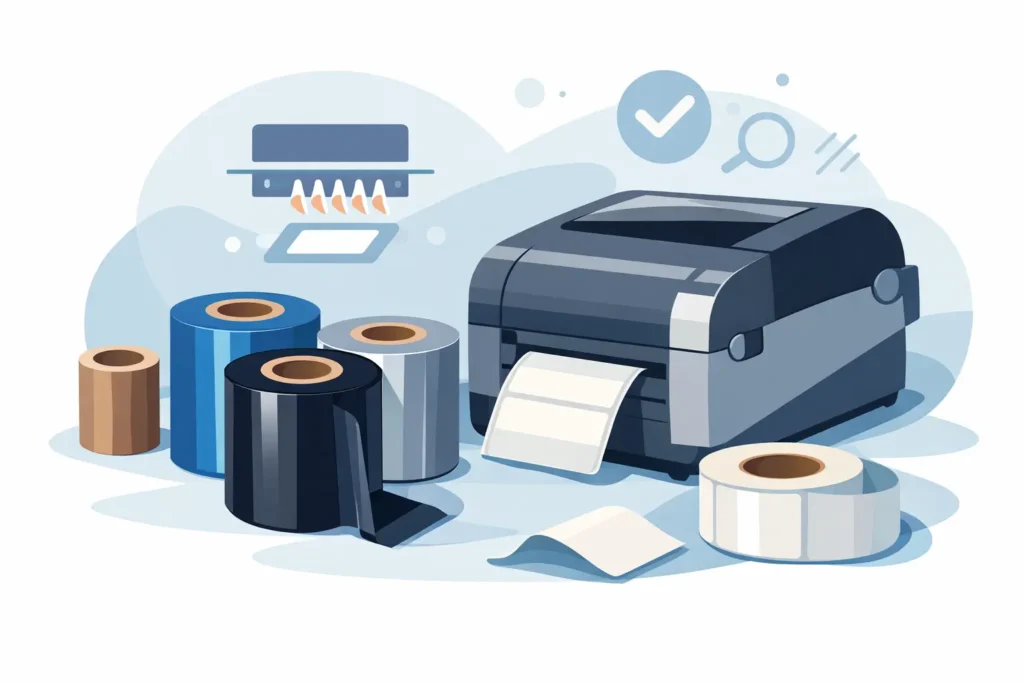
Most thermal transfer ribbon for labels falls into three categories: wax, wax-resin, and resin. Each has a different balance of cost, durability, and media compatibility.
Wax ribbons
Wax ribbons are often used for paper labels in shipping, warehousing, and general inventory applications. They are usually the most economical option and can produce dark, clean print at lower energy settings.
The trade-off is durability. Wax ribbons are more likely to scratch or smear under abrasion, heat, or chemical exposure. If labels are used only for short-term indoor tracking, that may be acceptable. If the label needs to stay readable through repeated handling or environmental exposure, wax can become the weak point.
Wax-resin ribbons
Wax-resin ribbons sit in the middle. They offer better resistance to scratching and smudging than wax while still working well on many coated paper labels and some synthetic materials.
For many operations, this is the practical starting point because it covers a wide range of use cases without moving immediately to a higher-cost resin ribbon. Product labels, shelf labels, compliance labels, and work-in-process applications often fall into this category. Still, results depend on the face stock and the conditions the label will face after printing.
Resin ribbons
Resin ribbons are built for durability. They are commonly used with synthetic labels such as polyester, polypropylene, and polyimide when the printed image must resist chemicals, abrasion, moisture, heat, or outdoor exposure.
They cost more, and they often require tighter alignment between ribbon, media, and printer settings. But when labels must endure harsh conditions, resin is usually the right answer. Asset tags, laboratory labels, electronics identification, rating plates, and long-term outdoor labels are common examples.
The label material matters as much as the ribbon
Ribbon decisions cannot be made in isolation. The same ribbon may perform well on one label stock and poorly on another. Paper labels and synthetic labels accept transferred ink differently, and top coatings also affect adhesion.
That is where many avoidable issues begin. A ribbon that prints beautifully on coated paper may not anchor well to polyester. A resin ribbon chosen for durability may be unnecessary if the label itself is paper and intended for short-term use. On the other hand, using a low-cost wax ribbon on a glossy synthetic stock can produce weak print that looks acceptable at first and fails later.
The most reliable approach is to evaluate the ribbon with the actual label material and the actual printer being used. That gives a truer picture than choosing by ribbon category alone.
Printer compatibility is not optional
Not every ribbon works equally well in every printer. Core size, ribbon width, ribbon length, winding direction, and printhead energy requirements all affect compatibility. Even when a ribbon physically fits, it may not produce the expected results if the printer settings are not tuned to that formulation.
Industrial operations especially need to pay attention here. A mismatch can cause poor print density, excess ribbon wrinkling, voids in the image, and unnecessary printhead wear. None of those problems are solved by buying a cheaper ribbon.
Printer brand and model matter, but so does how the printer is being used. High-volume runs, variable data printing, fine barcodes, and small text all place different demands on the ribbon and printhead setup. When print quality is inconsistent, the root cause may be less about the label design and more about the ribbon and printer combination.
How to match ribbon performance to the application
The easiest way to choose a thermal transfer ribbon for labels is to start with what the label must survive.
If the label is used for short-term shipping or indoor inventory control and does not need to resist much handling, a wax ribbon on a compatible paper label may be the most efficient choice. If the label will be touched frequently, moved through a warehouse, or exposed to moderate scuffing, a wax-resin ribbon often provides a better balance.
If the label must resist chemicals, weather, sterilization, high heat, outdoor storage, or long-term use, resin is usually the safer path. That is especially true for compliance and asset identification where failure creates downstream costs.
There is always a trade-off. Higher durability usually comes with a higher ribbon cost, and over-specifying can waste budget. But under-specifying often costs more in relabeling, downtime, rejected shipments, and traceability problems. The right choice is the one that fits the true operating conditions, not the best-case scenario.
Common signs you have the wrong ribbon
Operations teams often notice ribbon issues only after labels are in use. A few warning signs usually show up early.
Smearing after light handling suggests the ribbon is not bonding well to the label surface or the ribbon class is too soft for the application. Faded or incomplete print may point to incompatible media, poor printer settings, or a ribbon that requires different heat levels. Barcode scan failures can come from low contrast, weak edge definition, or ribbon wrinkling during print. Excessive printhead wear may indicate a low-quality ribbon or one not suited to the printer.
When those issues appear repeatedly, swapping ribbon types without testing the rest of the system rarely solves the problem for long. The better fix is to look at the full print setup – ribbon, label stock, printer configuration, and environmental demands.
Cost per roll is not the real cost
Ribbon pricing matters, but the lowest unit cost does not always produce the lowest operating cost. A ribbon that saves a few dollars per roll can become expensive if it causes unreadable labels, rescans, printhead replacement, or relabeling labor.
That is why experienced buyers evaluate total performance. How many labels print cleanly? How often do operators need to stop and adjust? How well do barcodes scan downstream? How long do labels last in the field? Those questions usually reveal more value than invoice price alone.
For companies managing multiple locations, standardizing the right ribbon and media combination can also reduce troubleshooting and improve consistency across sites. That consistency is often more valuable than chasing small savings on consumables.
A better way to buy thermal transfer ribbon for labels
The best purchasing decision is usually an application decision first. Start with the label surface, the printer model, required durability, barcode density, environmental exposure, and expected label life. Then test for print quality and resistance under real conditions, not just at the printer.
This is where a solutions-oriented supplier can make a measurable difference. Instead of treating ribbon as a standalone item, the right partner helps align consumables, hardware, and workflow requirements so the system performs as intended. For operations that depend on accurate identification, that guidance is often what prevents repeat failures.
PaladinID works with organizations that need labeling systems to perform in the real world, not just on paper. That includes helping teams identify the right ribbon and label combinations for their printers, environment, and operational goals.
The best ribbon is not the one with the broadest claims or the lowest price. It is the one that keeps your labels readable, your barcodes scannable, and your operation moving without avoidable interruptions. If a label has a job to do, the ribbon deserves the same level of scrutiny.


Got Labeling Questions? Our AI Assistant Has Answers - Chat Now!
For more information on PaladinID
Get Help With Your Next Label Project
We have over 35 years of providing exceptional service and labeling products to the world. Take the first step to an easy, stress-free solution for your label needs by contacting us.
Schedule a call below or email dritchie@paladinid.com
Make Your Mark
“Making companies more competitive by offering the correct label printing solution, on time, within budget, while creating unmatched value”.
About PaladinID, LLC
PaladinID develops and supports high-performance barcode labeling applications. We work with our clients to “Make Your Mark” by providing the expertise and tools necessary to create an entire product label printing solution. Located in central New Hampshire, PaladinID has been serving Massachusetts, Vermont, Maine, Connecticut, Rhode Island, New England, and beyond for over 30 years, and in 2017, became an RFID-certified company. We look forward to working with you.
You may be interested in our other services:
Product Labels
Product Labels
Labels for every type of application: Blank, Pre-printed, Variable data
Label Printers
Label Printers
We sell and support: Direct/thermal transfer, Inkjet, Laser
Printer Ribbons
Printer Ribbons
We sell ribbons for ALL barcode printers including: Zebra, Datamax, Sato, Intermec
Flexible Packaging
Flexible Packaging
We offer a wide variety of packaging containers for your products.
Label Software
Label Software
Software for all barcode printing and product labeling.
Label applicators
Label Applicators
Wide selection of applicators: Desktop/Mobile, Applicator only, Print & apply
