
How to Choose Harsh Environment Labels


What Can We Help You With?
A label that peels off a drum, smears in a washdown area, or stops scanning in the yard is not a minor nuisance. It slows receiving, disrupts production, creates traceability gaps, and forces teams to relabel inventory that should have moved the first time. That is why harsh environment labels matter. In industrial settings, the right label is part of process control, not just product identification.
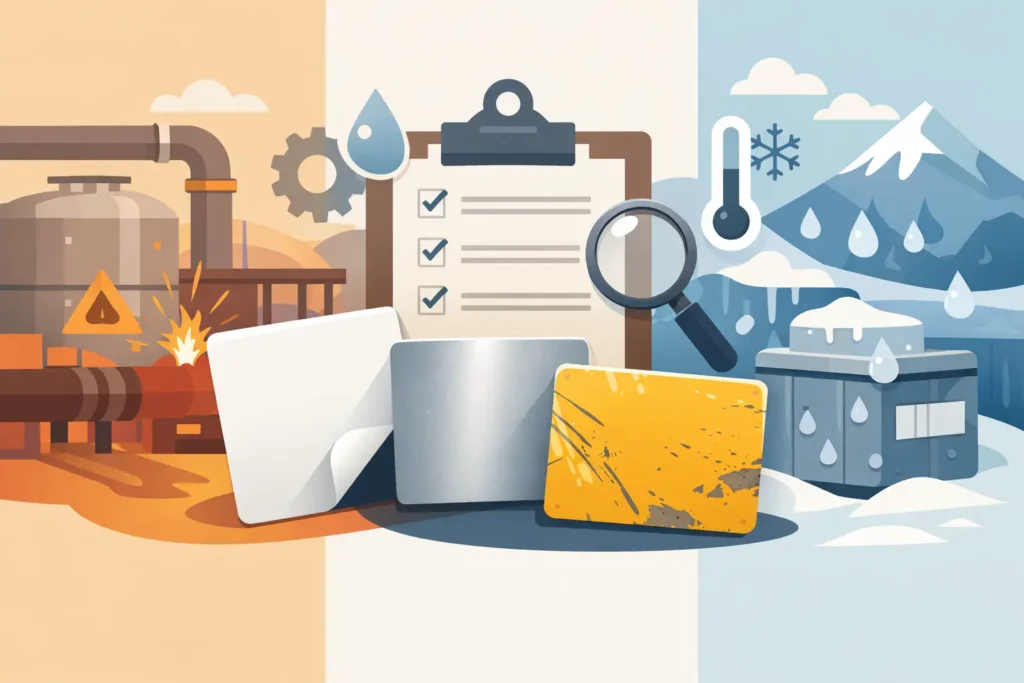
Operations teams usually see the failure first. A barcode fades after UV exposure. An adhesive lets go on cold metal. A ribbon choice looks fine on day one and becomes unreadable after chemical contact. When those problems show up repeatedly, the issue is rarely just the label stock by itself. It is usually a mismatch between material, adhesive, print method, surface, and environment.
What harsh environment labels are designed to handle
Harsh environment labels are built for conditions that standard paper labels and general-purpose adhesives cannot tolerate for long. That can mean sustained heat, freezing temperatures, outdoor weather, frequent handling, grease, solvents, washdowns, or rough surfaces. In some applications, the label also needs to survive years of exposure while keeping text and barcodes readable.
The specifics vary by industry. A manufacturer may need labels that stay in place through abrasion and high temperatures. A utility may need outdoor asset labels that resist sunlight and moisture. A healthcare or life sciences operation may need labels that tolerate refrigeration, chemicals, or sterilization steps. Warehouses and distribution environments often need durable rack, bin, and pallet labeling that can stand up to traffic and repeated scans.
That range is exactly why product selection should start with the application, not with a generic request for a durable label. Durable means different things in different workflows.
Why harsh environment labels fail
Most label failures trace back to a small number of causes. The first is surface mismatch. Metal, powder-coated equipment, corrugate, plastic totes, curved containers, and textured surfaces all behave differently. An adhesive that performs well on smooth plastic may struggle on oily steel or low-surface-energy materials.
The second is environmental exposure that was underestimated. A label may only need to survive normal indoor handling, or it may need to hold through heat cycling, outdoor weather, or chemical splash. Those are not small distinctions. A label built for warehouse shelving is not automatically suitable for a pipe yard, and a freezer-grade adhesive will not solve every cold-chain issue if condensation or rough application surfaces are part of the process.
The third is print durability. Teams sometimes choose the right facestock but overlook the print technology. In industrial applications, the image itself has to survive. If the barcode scratches off, fades, or bleeds, the label has still failed even if the adhesive stays put.
Start with the environment, not the label spec sheet
The fastest way to narrow options is to define what the label will actually face during its life. Temperature is usually the first factor, but it is not the only one. You also need to account for moisture, UV exposure, abrasion, chemicals, cleaning routines, and how often the item is handled or scanned.
It also helps to separate application conditions from service conditions. Some labels are applied at room temperature but must perform later in extreme heat or cold. Others need to be applied directly in cold environments, which can change adhesive requirements completely. If a label is going onto a surface that is dusty, oily, wet, or textured, that matters just as much as the eventual operating environment.
This is where many buying decisions improve. Instead of asking for the toughest label available, define the exact combination of factors the label needs to survive. That usually leads to a better result and often avoids overspending on a specification that does not fit the workflow.
Material and adhesive choices matter more than most teams expect
Facestock selection is one of the biggest drivers of performance. Polyester is common in industrial settings because it offers strong resistance to moisture, tearing, and many chemicals. Polypropylene can be useful where flexibility matters. Vinyl may be a fit for some outdoor or conformable applications. Paper still has a place in many operations, but not when long-term durability is the requirement.
Adhesive choice is just as critical. Permanent acrylic adhesives are common for durable applications, but not all acrylics perform the same way. Some are engineered for high heat, some for low temperatures, and some for challenging surfaces. Rubber-based adhesives can offer strong initial tack, which may help in certain situations, but they may not be the best fit for prolonged exposure to heat or UV.
There is no single best combination across all uses. A label for warehouse racking has a different profile than one used on chemical containers, outdoor assets, or returnable transport items. The right choice depends on what the label is attached to, how it is applied, and what happens next.
Printing harsh environment labels requires the right combination
When buyers focus only on label material, they can miss the rest of the system. Printers, ribbons, print resolution, and software settings all affect whether harsh environment labels perform as expected.
Thermal transfer printing is often the preferred method for industrial durability because the right ribbon and media combination can produce highly resistant images. Resin ribbons are typically used when chemical resistance, heat resistance, and abrasion resistance are priorities. Wax-resin ribbons can be a practical middle ground in less extreme conditions. Direct thermal can work for short-life applications, but it is usually not the best choice when long-term exposure or high durability is required.
Printer setup also matters. Darkness, speed, and heat settings affect image quality and ribbon transfer. A technically correct material can still produce poor barcode performance if the printer is not calibrated for that media. That is one reason operations teams often benefit from treating labels as part of a complete identification system rather than a standalone supply item.
Common use cases for harsh environment labels
In manufacturing, harsh environment labels are often used for work-in-process tracking, product identification, rating plates, and asset labels. These applications may involve heat, oils, solvents, abrasion, or repeated scanning across the production lifecycle.
In warehousing and logistics, durable labels support rack locations, bin markers, returnable containers, and outdoor inventory areas. The challenge is often less about one extreme condition and more about cumulative wear from forklifts, contact, dust, and scan volume.
For utilities, construction-related inventory, and outdoor equipment, UV resistance and adhesive stability are often central. The label has to remain attached and legible despite sunlight, rain, temperature swings, and dirty conditions. In healthcare and laboratory settings, labels may need to perform in refrigeration, freezers, or under exposure to cleaning agents and handling protocols.
Each of these examples points to the same principle. The label must match the workflow, not just the environment in general.
How to evaluate harsh environment labels before rollout
Testing should happen in the real application whenever possible. A bench test can screen options, but it cannot fully recreate field conditions. Apply candidate labels to actual surfaces, print them with the intended equipment, and expose them to the handling, temperatures, and contaminants they will encounter in use.
Barcode verification is worth including in that process. A label may look acceptable to the eye while scan performance degrades over time. If the label supports compliance, inventory control, or automated workflows, readability has to remain consistent throughout its service life.
It is also smart to test failure margins. If a label just barely survives under ideal application conditions, it may not hold up in day-to-day operations where surfaces are less than perfect or application practices vary by shift and location.
A better buying approach for long-term performance
The strongest label programs are usually built around standardization. That means reducing one-off material choices, aligning label construction with printer and ribbon compatibility, and documenting which products are approved for specific use cases. It also means considering replenishment, support, and technical guidance before a problem reaches the floor.
This is where an experienced labeling partner can make a measurable difference. Instead of buying stock labels, ribbons, and printers separately and hoping they work together, teams can evaluate the full system with application details in mind. PaladinID supports that kind of approach by helping businesses match materials, print technology, and workflow requirements to real operating conditions.
Harsh environment labeling is rarely solved by choosing the thickest or most expensive material on the datasheet. The better answer is usually more precise than that. When the label, adhesive, print method, and application process are aligned, identification stays readable, scanning stays reliable, and operations spend less time fixing preventable failures.
A durable label should quietly do its job for as long as your process needs it to. If it draws attention, it is usually because something in the system was asked to do work it was never designed to handle.


Got Labeling Questions? Our AI Assistant Has Answers - Chat Now!
For more information on PaladinID
Get Help With Your Next Label Project
We have over 35 years of providing exceptional service and labeling products to the world. Take the first step to an easy, stress-free solution for your label needs by contacting us.
Schedule a call below or email dritchie@paladinid.com
Make Your Mark
“Making companies more competitive by offering the correct label printing solution, on time, within budget, while creating unmatched value”.
About PaladinID, LLC
PaladinID develops and supports high-performance barcode labeling applications. We work with our clients to “Make Your Mark” by providing the expertise and tools necessary to create an entire product label printing solution. Located in central New Hampshire, PaladinID has been serving Massachusetts, Vermont, Maine, Connecticut, Rhode Island, New England, and beyond for over 30 years, and in 2017, became an RFID-certified company. We look forward to working with you.
You may be interested in our other services:
Product Labels
Product Labels
Labels for every type of application: Blank, Pre-printed, Variable data
Label Printers
Label Printers
We sell and support: Direct/thermal transfer, Inkjet, Laser
Printer Ribbons
Printer Ribbons
We sell ribbons for ALL barcode printers including: Zebra, Datamax, Sato, Intermec
Flexible Packaging
Flexible Packaging
We offer a wide variety of packaging containers for your products.
Label Software
Label Software
Software for all barcode printing and product labeling.
Label applicators
Label Applicators
Wide selection of applicators: Desktop/Mobile, Applicator only, Print & apply
