
Warehouse Rack Barcode Labels That Last




What Can We Help You With?
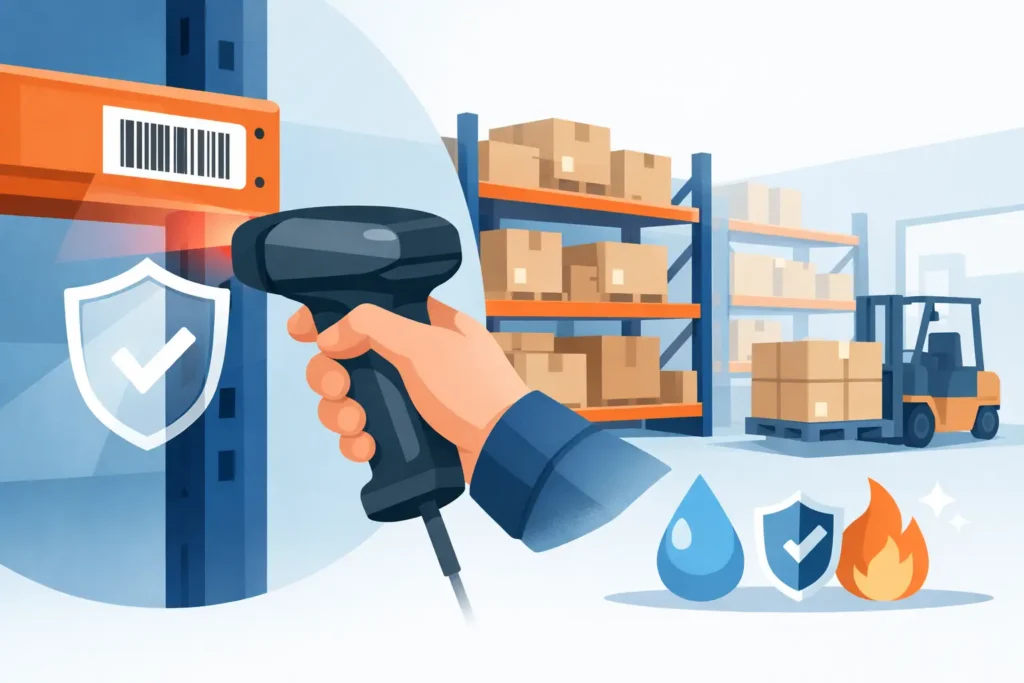
A missed scan on a rack label does not stay a small problem for long. It turns into picking delays, inventory questions, rework, and avoidable labor costs. That is why warehouse rack barcode labels need to be treated as part of the operating system of the warehouse, not as an afterthought.
In most facilities, rack labels sit in a punishing environment. Forklift traffic, pallet impact, dust, temperature swings, cleaning routines, and constant scanning all work against long-term readability. A label that looked fine on day one can become a weak point by day ninety if the material, adhesive, barcode size, or mounting method was chosen without regard to the actual rack and workflow.
Why warehouse rack barcode labels matter
Rack labels do more than identify a location. They connect physical storage positions to the warehouse management system, direct operators to the correct bay or level, and support accurate cycle counting and replenishment. When they are clear and consistent, travel paths are faster, training is easier, and scan compliance improves.
When they fail, the effects are immediate. Operators may key entries manually, scan the wrong location, or skip confirmation steps to keep work moving. That creates a familiar chain reaction – pick errors, inventory discrepancies, delayed investigations, and reduced confidence in the data. In a busy operation, even a small percentage of unreadable labels can become a daily drag on performance.
The practical value of a rack label is not just that it carries a barcode. It has to scan from the expected distance, remain legible under warehouse lighting, and stay attached through normal wear. A barcode that is technically correct but poorly placed or easily damaged is still a failed implementation.
What makes warehouse rack barcode labels work in the field
The right design starts with the location itself. Not every rack, beam, upright, or shelf should be labeled the same way. Selective pallet racking, cantilever systems, flow racks, shelving, and floor-level reserve locations often require different label constructions and placement strategies.
Material and adhesive selection
Material choice should follow the environment, not habit. Paper labels may be acceptable for short-term indoor use in controlled areas, but they are rarely the best fit for active rack identification. In most warehouses, synthetic materials are the safer choice because they resist abrasion, moisture, and handling damage more effectively.
Adhesive matters just as much. Powder-coated beams, painted uprights, rough metal, cold environments, and dusty surfaces can all affect bond strength. In some cases, direct adhesive labels perform well. In others, a magnetic label, placard, retroreflective label, or protected label holder is the better option. The trade-off is straightforward: removable solutions can support layout changes, while permanent constructions usually provide better resistance to impact and tampering.
Barcode symbology and size
A barcode should match both the system requirements and the scanning conditions. Code 128 is common for location labeling because it is compact and efficient, but the correct symbology depends on your WMS, scanner configuration, and data structure. The bigger concern in practice is often size and quiet zone, not just barcode type.
If operators scan from a forklift or from several feet away, the barcode needs to be sized for that working distance. Labels that are too small may pass print verification at the bench but fail during live use. Human-readable text is also important. When a scanner cannot read a damaged symbol, the operator still needs a clear visual reference to confirm the location.
Placement and protection
A well-printed label can still under perform if it is mounted in the wrong spot. Rack labels should be easy to see from the normal approach path and placed where they are less likely to be hit by pallets or worn down by contact. For lower levels, that may mean offset positioning or use of protected label holders. For high-bay storage, larger format labels or hanging signage may be required to support long-range scanning.
There is also a balance between visibility and vulnerability. A label placed at the front of the beam is convenient, but if that beam takes frequent pallet contact, the label may degrade quickly. Protective over laminates, rigid placards, and strategic placement can extend service life without sacrificing usability.
Common mistakes that shorten label life
Many rack labeling problems come from treating location labels like standard shipping labels. They are not the same application. Shipping labels are often temporary and disposable. Rack labels are part of fixed infrastructure.
One common mistake is using desktop-grade materials or office printers for industrial rack labels. That can lead to inconsistent print density, poor adhesion, and limited durability. Another is selecting a label based on unit price alone. A cheaper label that has to be replaced repeatedly is usually more expensive once labor disruption is considered.
Surface preparation is another overlooked issue. Labels applied to dirty, oily, or dusty rack surfaces often fail early, even when the adhesive itself is appropriate. In cold environments, application temperature can also affect results. A warehouse freezer or refrigerated area may require a different adhesive and a more controlled installation process.
Data inconsistency causes a different kind of failure. If naming conventions, barcode formatting, or rack numbering logic are unclear, labels may scan correctly but still confuse operators. Good rack identification requires both physical durability and logical structure.
How to choose the right rack label system
The best approach is to think in systems, not individual parts. The label material, printer, ribbon, software, data source, and installation method all affect the final result. If one piece is mismatched, performance suffers.
Start with the workflow
Look at how operators move through the facility. Are they scanning on foot, from lift trucks, or from mobile computers mounted to equipment? Are locations scanned at close range or from several feet away? Are labels exposed to impact, washdown, sunlight, or temperature changes? These details determine label size, print method, and placement.
Match print technology to durability needs
For many warehouse rack applications, thermal transfer printing is the preferred choice because it provides durable image quality on synthetic materials. The ribbon and label material need to be compatible, and the printer must be capable of producing consistent barcode quality at the required size. This is especially important for facilities printing variable location labels in-house or managing expansion projects over time.
Pre-printed labels can be a strong option when the layout is fixed and standardization is critical. They can simplify deployment and improve consistency across large installations. On the other hand, operations with frequent re-slotting or growth may benefit from in-house printing for flexibility. It depends on how often locations change and who will manage updates.
Consider future changes
Warehouses rarely stay static. A rack labeling plan should account for added aisles, revised numbering, changes in picking methods, or migration to new software. It helps to choose a format that can scale without forcing a complete relabeling project later.
This is where experienced guidance makes a difference. A provider that understands labels, printers, software, and application conditions can help avoid the common mismatch between what looks good in a catalog and what performs on the warehouse floor. That is often the difference between a labeling purchase and a reliable identification system.
Installation and maintenance are part of performance
Even the best labels need disciplined installation. Surfaces should be cleaned correctly, labels aligned consistently, and barcode orientation standardized across the facility. If labels are applied unevenly or in inconsistent positions, scan speed drops and operator frustration rises.
Routine inspection also matters. Rack labels should be checked during cycle counts, layout updates, or safety reviews. If a label is curling, torn, or fading, replacing it early prevents larger process issues later. Facilities with heavy traffic often benefit from keeping replacement labels and printer supplies readily available so maintenance does not turn into a delayed project.
For operations managing multiple sites, standardization is especially valuable. Consistent label construction, numbering logic, and printer settings reduce confusion when teams move between facilities or compare inventory data across locations.
The real goal is scan reliability
Warehouse rack barcode labels are successful when nobody has to think about them. Operators scan, confirm, and move on. Inventory stays aligned with the system. Training gets easier because location logic is visible and consistent. Supervisors spend less time chasing preventable errors.
That level of reliability comes from making careful decisions up front – material, adhesive, print method, barcode design, placement, and support. For facilities that depend on accurate inventory movement, those decisions are operational, not cosmetic. A durable rack label is a small component, but it carries a large share of daily accuracy.
If your current labels are peeling, fading, or slowing scans, the fix is rarely just a new roll of labels. It is usually a better fit between the environment, the workflow, and the identification system behind it. That is where a partner like PaladinID can help turn rack labeling from a recurring problem into a stable part of warehouse performance.
At PaladinID, we understand that every labeling application is different.
That’s why companies across the country trust us to help them identify the right solution for their business. With over 40 years of experience and one of the industry’s largest selections of labeling products, we make it easy to find the right fit for your operation. Whether you need stock products or a custom-built solution, our team is ready to help. Visit our online catalog, Email us, or call us today at 888.972.5234.
PaladinID delivers label solutions that stick!


Got Labeling Questions? Our AI Assistant Has Answers - Chat Now!
For more information on PaladinID
Get Help With Your Next Label Project
We have over 35 years of providing exceptional service and labeling products to the world. Take the first step to an easy, stress-free solution for your label needs by contacting us.
Schedule a call below or email dritchie@paladinid.com
Make Your Mark
“Making companies more competitive by offering the correct label printing solution, on time, within budget, while creating unmatched value”.
About PaladinID, LLC
PaladinID develops and supports high-performance barcode labeling applications. We work with our clients to “Make Your Mark” by providing the expertise and tools necessary to create an entire product label printing solution. Located in central New Hampshire, PaladinID has been serving Massachusetts, Vermont, Maine, Connecticut, Rhode Island, New England, and beyond for over 30 years, and in 2017, became an RFID-certified company. We look forward to working with you.
You may be interested in our other services:
Product Labels
Product Labels
Labels for every type of application: Blank, Pre-printed, Variable data
Label Printers
Label Printers
We sell and support: Direct/thermal transfer, Inkjet, Laser
Printer Ribbons
Printer Ribbons
We sell ribbons for ALL barcode printers including: Zebra, Datamax, Sato, Intermec
Flexible Packaging
Flexible Packaging
We offer a wide variety of packaging containers for your products.
Label Software
Label Software
Software for all barcode printing and product labeling.
Label applicators
Label Applicators
Wide selection of applicators: Desktop/Mobile, Applicator only, Print & apply
