
GHS Chemical Drum Labels That Hold Up




What Can We Help You With?
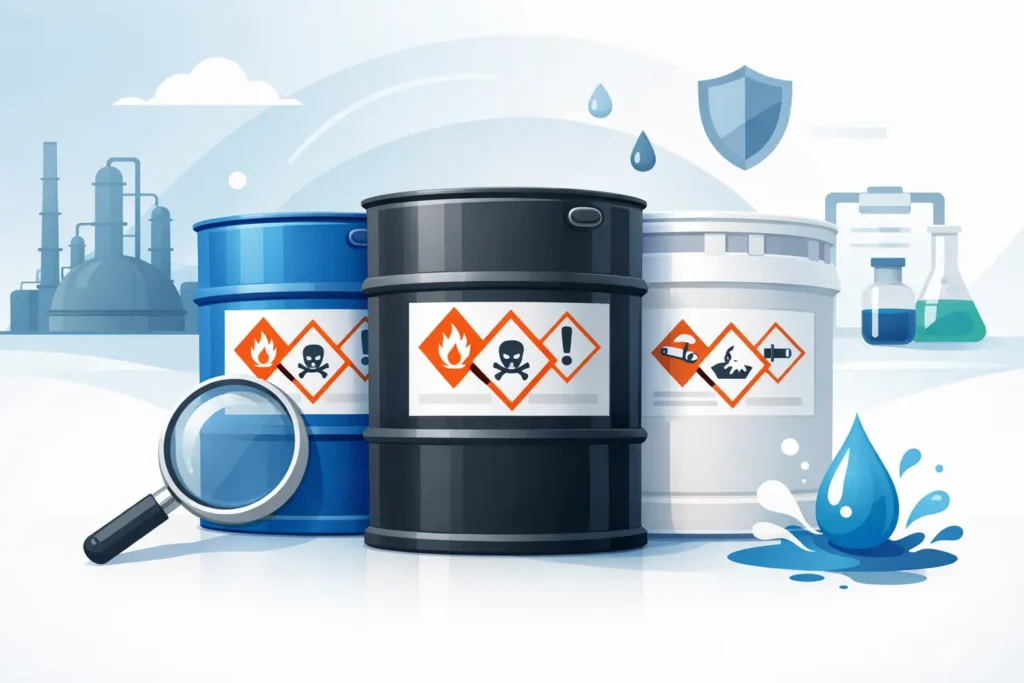
A drum label that curls, smears, or disappears under chemical exposure creates more than an identification problem. It can slow receiving, disrupt storage workflows, and expose your operation to compliance risk. That is why GHS chemical drum labels need to be treated as part of your labeling system, not as a simple sticker order.
For operations teams, EHS managers, and procurement leaders, the challenge is usually not understanding that a drum needs a GHS-compliant label. The challenge is ensuring the label remains legible throughout filling, transport, warehouse handling, outdoor exposure, and final use. In real facilities, labels are exposed to abrasion, moisture, temperature fluctuations, solvents, and rough handling by forklifts and warehouse staff. A design that works on paper can still fail on the drum.
What GHS chemical drum labels need to do
At a basic level, GHS chemical drum labels must communicate hazard information clearly and consistently. That includes the product identifier, signal word, hazard statements, precautionary statements, supplier information, and the required pictograms when applicable. But on an operating floor, the job is broader than compliance language alone.
The label also needs to support fast identification at a distance, accurate inventory handling, and dependable traceability. Many organizations add barcodes, lot numbers, batch details, internal item codes, or storage instructions to the same label. That is where label design becomes operational. The more data you need to carry, the more important print quality, sizing, and media selection become.
There is also a practical trade-off. A label can be fully compliant in content but still ineffective if the text is too small, the print resolution is poor, or the material does not bond well to the drum surface. In industrial labeling, compliance and durability have to work together.
Why are drum applications harder than standard container labeling
A chemical drum is not a clean, flat carton stored in a climate-controlled room. It may be steel, plastic, or fiber. It may have a textured, curved, dusty, or slightly contaminated surface. It may be stored indoors for one week or outdoors for six months.
That matters because adhesive performance varies with the substrate and environment. A label that adheres well to a smooth HDPE drum may not perform as well on a coated steel surface. Cold application can reduce tack. High heat can soften adhesives. Chemical splash can attack both the face stock and the print.
Drum handling adds another layer. Labels are scraped by pallets, rubbed during transport, and exposed to repeated contact in staging areas. If the operation uses secondary containment, washdown procedures, or aggressive cleaning agents, the label must withstand those conditions as well. This is why many off-the-shelf office labels fail quickly in chemical environments.
Choosing the right material for GHS chemical drum labels
Material selection is where many labeling programs either gain reliability or begin to create rework. Paper labels may look cost-effective up front, but in many drum applications, they are the wrong fit. Moisture, abrasion, and chemical contact can break them down fast.
For most industrial chemical drum use, synthetic materials such as polyester or polypropylene are a stronger choice. Polyester is often preferred where chemical resistance, dimensional stability, and long-term legibility matter most. Polypropylene can be a solid option in applications that need durability with some flexibility in cost. The best choice depends on exposure conditions, storage duration, and whether the label must survive only internal handling or the full supply chain.
Adhesive selection is just as important as face stock. Permanent industrial adhesives are common for drum labeling, but not all permanent adhesives behave the same way. Some are built for high initial tack on difficult surfaces. Others are better for cold-temperature application or long-term outdoor use. If drums are slightly oily, dusty, or exposed to humidity, the adhesive must be matched to these conditions.
Topcoat matters too. If you are thermal transfer printing variable information, the label surface needs to accept the ribbon properly and protect the printed image from smearing or scratching. Without the right surface treatment, even a durable base material can underperform.
Print method matters more than many buyers expect
A durable label stock will not fix a poor print process. For GHS chemical drum labels, print technology directly affects readability and lifespan.
Thermal transfer printing is often the strongest fit for industrial operations because it supports sharp text, scannable barcodes, and durable variable data when paired with the right ribbon. Resin or wax-resin ribbons are commonly used depending on the required resistance to abrasion, heat, and chemical exposure. In harsher applications, a full resin ribbon is often the better investment because it produces a more durable image.
Laser and inkjet methods may work in certain environments, especially for low-exposure or short-term use, but they are often less dependable once chemical contact, moisture, or heavy handling comes into play, until now! If a drum label includes critical hazard communication and internal tracking data, fading or smudging is not a minor issue.
Printer setup also deserves attention. Darkness, speed, printhead condition, and ribbon compatibility all affect output. A label can fail because the wrong printer setting created weak image transfer, not because the label material itself was flawed. That is why the best labeling results usually come from evaluating media, ribbon, printer, and application conditions together.
Design for compliance and usability
A drum label has to be readable by people who are moving quickly, wearing PPE, and working in less-than-perfect conditions. That should influence the design.
Pictograms need to be clear and correctly reproduced. Text should be sized for real-world reading, not just to fit everything into a small format. If your operation also requires barcode scanning, the code must be placed where curvature and glare will not interfere with scan performance. Trying to compress too much information into one undersized label often creates avoidable problems.
Label placement matters as well. On a curved drum surface, edge lift is more likely if the label is oversized or placed across irregular areas. Some operations benefit from multiple labels on different sides of the drum to improve visibility in storage racks or staging zones. That adds cost, but it can reduce handling errors and save time during audits, picking, and inspections.
There is no single perfect label layout for every facility. A warehouse with high-rack storage has different visibility needs than a production floor with point-of-use drums. The right format depends on how your teams actually receive, store, move, and use the material.
Where labeling programs usually break down
Most drum labeling issues are not caused by one dramatic failure. They come from small mismatches that build into larger operational problems.
Sometimes the SDS and label content are correct, but the warehouse is using a stock label material that was never intended for chemical exposure. In other cases, the printer and ribbon were selected for shipping labels and then repurposed for hazardous material labeling. Some companies standardize a single label across all drum types without accounting for differences between steel and plastic surfaces.
Another common issue is inconsistent variable data. If batch numbers, date codes, or internal product identifiers are pulled manually from different systems, errors creep in. That affects traceability and can create confusion between compliance labeling and inventory labeling. The more complex the workflow, the more valuable it becomes to standardize label templates, approved media, printer settings, and data inputs.
This is where a complete labeling approach pays off. The label, ribbon, printer, software, and operating environment all influence the result. When those parts are selected independently, it is easy to end up troubleshooting the same failures repeatedly.
Building a more reliable GHS chemical drum labels process
A stronger process usually starts with asking better application questions. What is the drum material? Where is it stored? What chemicals may contact the label? How long must it remain legible? Is the label preprinted, printed on demand, or both? Will it include barcodes or variable lot data? Those details determine whether a standard solution is enough or a more specialized construction is needed.
Testing is worth the time. A short trial on actual drums in actual operating conditions can reveal edge lift, print abrasion, scan issues, or chemical attack before a full rollout. That matters more than a promising product spec sheet. Real-world performance is the standard that counts.
It also helps to work with a supplier that understands the full labeling system. PaladinID supports businesses that need more than a box of labels – they need materials, printers, ribbons, and technical guidance that perform together in the field. That kind of support is especially useful when compliance requirements and operational demands overlap.
If your team is reviewing GHS chemical drum labels, the right question is not just whether the label meets the regulation on day one. The better question is whether it will still be readable, attached, and usable after your operation has done everything it normally does to a drum.
At PaladinID, we understand that every labeling application is different.
That’s why companies across the country trust us to help them identify the right solution for their business. With over 40 years of experience and one of the industry’s largest selections of labeling products, we make it easy to find the right fit for your operation. Whether you need stock products or a custom-built solution, our team is ready to help. Visit our online catalog, Email us, or call us today at 888.972.5234.
PaladinID delivers label solutions that stick!


Got Labeling Questions? Our AI Assistant Has Answers - Chat Now!
For more information on PaladinID
Get Help With Your Next Label Project
We have over 35 years of providing exceptional service and labeling products to the world. Take the first step to an easy, stress-free solution for your label needs by contacting us.
Schedule a call below or email dritchie@paladinid.com
Make Your Mark
“Making companies more competitive by offering the correct label printing solution, on time, within budget, while creating unmatched value”.
About PaladinID, LLC
PaladinID develops and supports high-performance barcode labeling applications. We work with our clients to “Make Your Mark” by providing the expertise and tools necessary to create an entire product label printing solution. Located in central New Hampshire, PaladinID has been serving Massachusetts, Vermont, Maine, Connecticut, Rhode Island, New England, and beyond for over 30 years, and in 2017, became an RFID-certified company. We look forward to working with you.
You may be interested in our other services:
Product Labels
Product Labels
Labels for every type of application: Blank, Pre-printed, Variable data
Label Printers
Label Printers
We sell and support: Direct/thermal transfer, Inkjet, Laser
Printer Ribbons
Printer Ribbons
We sell ribbons for ALL barcode printers including: Zebra, Datamax, Sato, Intermec
Flexible Packaging
Flexible Packaging
We offer a wide variety of packaging containers for your products.
Label Software
Label Software
Software for all barcode printing and product labeling.
Label applicators
Label Applicators
Wide selection of applicators: Desktop/Mobile, Applicator only, Print & apply
