
Choosing the Right Industrial Labeling Machine




What Can We Help You With?
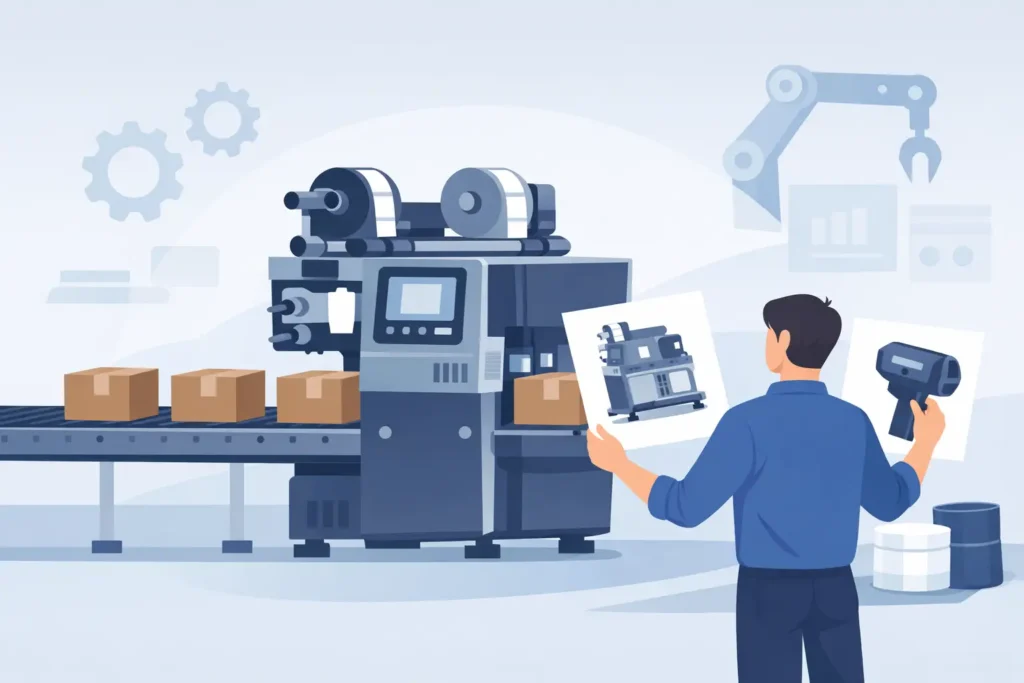
When a label fails on a pallet, drum, tote, or product line item, the problem rarely stops at the label. It shows up as a misread barcode, a shipping delay, a compliance issue, or a manual workaround that pulls people off more valuable work. That is why selecting the right industrial labeling machine is less about buying equipment and more about protecting throughput, traceability, and day-to-day reliability.
For operations leaders, warehouse teams, and procurement stakeholders, the real question is not simply which machine can apply a label. The better question is which system will keep performing in your environment, with your materials, at your required speeds, and with the data your business depends on.
What an industrial labeling machine needs to do
In industrial settings, labels are part of the workflow, not an afterthought. They carry product IDs, lot codes, shipping details, asset information, compliance data, and barcodes that need to scan the first time. A machine that works well in a clean, controlled demo may struggle when exposed to dust, temperature swings, high-volume runs, rough handling, or variable product sizes.
That is why equipment selection should start with the application. Some operations need print-and-apply capability for shipping lines. Others need consistent labeling on cases, pallets, drums, racks, or returnable containers. In many environments, the label itself is only one part of the equation. Printer performance, ribbon compatibility, software integration, sensor accuracy, and media durability all influence whether the overall system works.
An industrial labeling machine should support repeatable placement, readable output, and dependable uptime. If it cannot do all three, the cost of errors can outweigh any short-term savings on the initial purchase.
How to evaluate an industrial labeling machine for real operations
The most common buying mistake is focusing too heavily on machine specifications without considering the actual workflow. Speed matters, but so do surfaces, label sizes, data sources, operator interaction, and maintenance demands.
Start with the product and surface
Flat corrugate cases are one thing. Curved containers, shrink-wrapped packs, lumber, pipes, nursery pots, or chemical drums are another. Surface texture, moisture, dust, and temperature can all affect adhesion and application consistency. A machine that performs well on uniform cartons may not be the right fit for irregular or harsh-environment labeling.
This is where the broader system matters. Label construction, adhesive selection, and print method have to match the substrate and the environment. If labels are lifting, smearing, or becoming unreadable after application, the issue may not be the applicator alone.
Match speed to the line, not just the brochure
High speed capability sounds attractive, but overspecifying can add cost and complexity without solving the core need. On the other hand, underspecifying a machine for a growing operation leads to bottlenecks, missed labels, and operator intervention.
The right target is sustainable speed in your production conditions. That includes startup and stop cycles, product spacing, data changes, and the consistency of upstream and downstream equipment. A machine rated for a certain speed in ideal conditions may perform differently in a mixed-product environment.
Consider barcode quality and data accuracy
A label that is applied straight but printed poorly still creates operational risk. If your labeling process involves variable data such as lot numbers, serial numbers, SKU details, or shipping information, print quality and data control need close attention.
That means reviewing resolution requirements, ribbon and media pairing, software compatibility, and how data reaches the machine. Poor integration can create duplicate labels, incorrect field mapping, or delays when operators need to manually enter information. For many businesses, the strongest improvement comes from treating labeling as a connected identification system rather than a standalone device purchase.
Environmental conditions change the answer
Industrial environments are rarely gentle. Warehouses generate dust. Manufacturing floors create vibration. Outdoor and semi-outdoor operations introduce heat, cold, humidity, and UV exposure. Healthcare and life sciences settings may require cleaner processes and strict data control. Recycling, utilities, and lumber operations often demand labels that can survive abrasion and rough handling.
These conditions affect both the machine and the media. A standard setup may be fine in one facility and fail quickly in another. It depends on where labeling happens, how products are stored, and what the label must endure after application.
That is why durability should be defined in practical terms. Does the label need to last through transport only, or remain legible for months in the field? Does the barcode need to scan after exposure to chemicals or weather? Will operators be changing rolls frequently, and if so, how easy is that process under production pressure?
Integration often matters more than the hardware
A strong machine can still underperform if it does not fit the rest of the operation. Integration affects speed, error rates, and the amount of labor required to keep labels moving.
Software and data systems
Many industrial labeling environments rely on ERP, WMS, MES, or custom databases to generate label data. If the machine and software do not communicate cleanly, teams end up printing from disconnected systems, applying workarounds, or correcting errors after the fact. That increases the chance of the wrong label reaching the wrong item.
The better approach is to confirm how templates are managed, where data originates, how users are controlled, and what happens when formats change. Labeling should support process discipline, not depend on individual operator memory.
Consumables and replacement parts
Downtime is rarely caused by hardware alone. Ribbons, labels, printheads, and wear components all influence long-term performance. A machine may look cost-effective upfront but become expensive if consumables are hard to source, printheads fail early, or maintenance requires excessive intervention.
This is one reason experienced buyers look beyond unit price. They evaluate total operating reliability, support availability, and whether the full labeling ecosystem is aligned. In practice, a dependable supply of matched media and replacement parts can be as important as the applicator itself.
Common selection mistakes
One common mistake is assuming all industrial labeling needs are basically the same. They are not. A pallet labeling application has different requirements than product-level variable data labeling. A warehouse shipping line has different priorities than an asset tracking program or a compliance labeling process.
Another mistake is buying for the current pain point only. If your operation expects growth, SKU expansion, additional barcode requirements, or wider software integration, the machine should support that path. Otherwise, a quick fix becomes a replacement project sooner than expected.
A third issue is treating support as secondary. Installation, calibration, operator training, and troubleshooting all affect the success of the deployment. Even strong equipment benefits from guidance during setup and optimization, especially when workflows involve multiple materials, data sources, or environmental variables.
What good implementation looks like
The best industrial labeling machine deployments usually begin with a site-specific evaluation. That means understanding what is being labeled, where the label is applied, what data is required, and what conditions the label must survive. It also means reviewing current failure points, whether those are unreadable barcodes, inconsistent placement, slow changeovers, or repeated manual relabeling.
From there, the right solution often includes more than one component. Labels, printers, ribbons, software, and application equipment need to work as a coordinated system. For many organizations, that is where a consultative partner adds value. Instead of piecing together hardware and supplies from separate sources, they can build around performance requirements and support the result over time. That approach is central to how PaladinID helps customers reduce risk and improve labeling consistency in demanding operations.
A practical way to make the final decision
Before choosing a machine, ask what failure would actually cost your operation. If the answer includes shipping errors, production delays, compliance exposure, or inventory confusion, then the cheapest option is rarely the lowest-cost choice.
A better decision process looks at label performance, machine fit, software compatibility, maintenance needs, and supplier support together. It also leaves room for reality. Some operations need maximum speed. Others need flexibility across products. Others need durability above all else. There is no single best machine for every environment, only the right fit for the workflow you need to protect.
The most reliable labeling systems are the ones built with the full process in mind. When your machine, media, data, and support structure are aligned, labels stop being a recurring problem and start doing what they are supposed to do – keep the operation moving.
At PaladinID, we understand that every labeling application is different.
That’s why companies across the country trust us to help them identify the right solution for their business. With over 40 years of experience and one of the industry’s largest selections of labeling products, we make it easy to find the right fit for your operation. Whether you need stock products or a custom-built solution, our team is ready to help. Visit our online catalog, Email us, or call us today at 888.972.5234.
PaladinID delivers label solutions that stick!


Got Labeling Questions? Our AI Assistant Has Answers - Chat Now!
For more information on PaladinID
Get Help With Your Next Label Project
We have over 35 years of providing exceptional service and labeling products to the world. Take the first step to an easy, stress-free solution for your label needs by contacting us.
Schedule a call below or email dritchie@paladinid.com
Make Your Mark
“Making companies more competitive by offering the correct label printing solution, on time, within budget, while creating unmatched value”.
About PaladinID, LLC
PaladinID develops and supports high-performance barcode labeling applications. We work with our clients to “Make Your Mark” by providing the expertise and tools necessary to create an entire product label printing solution. Located in central New Hampshire, PaladinID has been serving Massachusetts, Vermont, Maine, Connecticut, Rhode Island, New England, and beyond for over 30 years, and in 2017, became an RFID-certified company. We look forward to working with you.
You may be interested in our other services:
Product Labels
Product Labels
Labels for every type of application: Blank, Pre-printed, Variable data
Label Printers
Label Printers
We sell and support: Direct/thermal transfer, Inkjet, Laser
Printer Ribbons
Printer Ribbons
We sell ribbons for ALL barcode printers including: Zebra, Datamax, Sato, Intermec
Flexible Packaging
Flexible Packaging
We offer a wide variety of packaging containers for your products.
Label Software
Label Software
Software for all barcode printing and product labeling.
Label applicators
Label Applicators
Wide selection of applicators: Desktop/Mobile, Applicator only, Print & apply
